
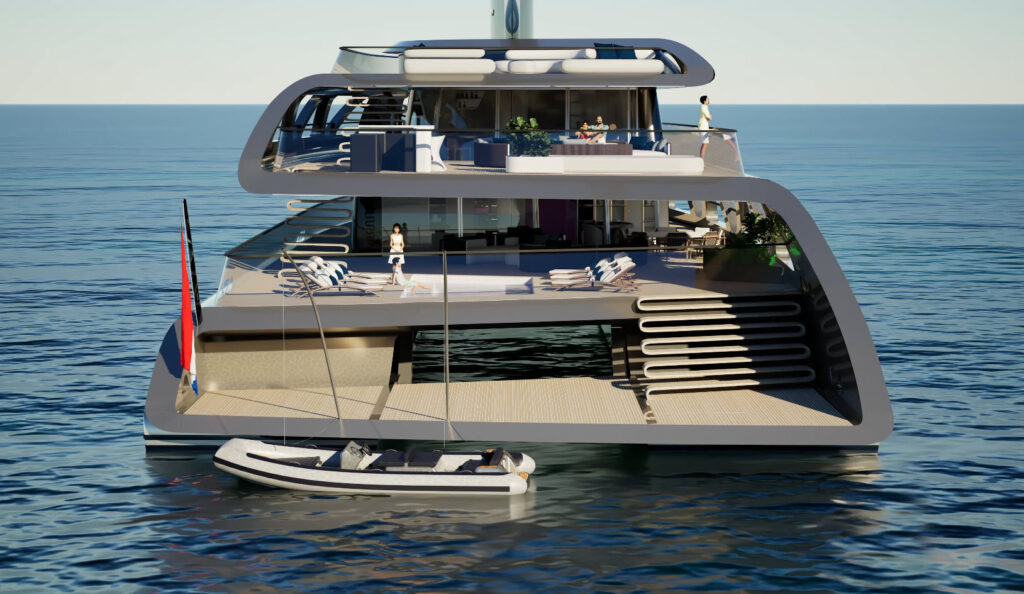

Sure, a sailboat powered by only the wind produces zero emissions by definition, but when it’s a sailing superyacht, the carbon footprint becomes a real drag. Royal Huisman, the yard that launched the first hybrid superyacht, 2009’s Ethereal, went a step further last year with its Project Tidal Shift sustainability initiative. One of the results is the near-zero-emissions Aera concept.
Focused on automated cruising using proven technology, Aera conceptualizes a 164-foot catamaran that features an open, serpentine-shaped exterior and is powered by a 115-foot carbon-fiber wing sail. Aera’s development was driven in part by answering the challenge of mutual exclusivity.
“For me, the spark was [addressing] how do we make a yacht that can use the power of the wind to decarbonize, without needing 10 crew to pull up sails,” says Iain Percy, a former Olympian and America’s Cup competitor whose company Artemis Technologies has designed advanced wing sails and foiling hulls for the America’s Cup and SailGP racing series.
The Artemis team worked closely with Rondal, Royal Huisman’s composites and spars subsidiary, to create Aera’s giant, one-of-a-kind sail with a leading edge shaped like an airfoil and a total surface area measuring 2,640 square feet. Yet despite its size, the wing has 10 times less drag than a conventional mast but is so efficient that a traditional rig would need 60 to 80 percent more sail area to match its power.
Two electric motors around the mast column rotate the wing, while onboard computers make constant micro adjustments as part of the automated sail-control system. “The captain enters the destination, sets the wing to automatic trim, and you are sailing in less than a minute,” says Jan Timmerman, Royal Huisman’s C.E.O. “It is basically as easy as operating a motor yacht.”
When the wind is insufficient, propulsion will come from two retractable electric-drive propellers that draw power from the 580 kWh battery bank. Fully charged batteries can run the hotel load for 11 hours, while the hydrogen fuel cells generate over 3,000 kWh for 72 hours at anchor. Biodiesel-fed generators, with minimal emissions, can also provide reliable output for distance cruising.
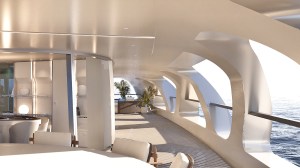
Designer Cor D. Rover, in an attempt to have Aera further “radiate the future,” combined an asymmetrical hull with three open, interlinked decks that maximize alfresco living. “A catamaran is the perfect platform for inherent stability under sail,” says Rover, noting that Aera heels only two degrees. “On top of that, you get phenomenal decks.” Using Aera’s 47-foot-wide beam to optimal effect, Rover created a breezy, open-plan layout with shaded walkways between irregularly shaped common areas. The 7,212 square feet of exterior space is comparable to that of a conventional yacht measuring 70 feet longer.
Aera is also infused with lavish touches: The owner’s suite, complemented by a private exterior terrace and pool, sits forward in the main deck, while the rear presents another pool and open stern on the water. With Aera, all the pieces of the zero-emissions superyacht puzzle seem to be in place—save for the last. Says Rover, “We need just one young tech billionaire who embraces this.